
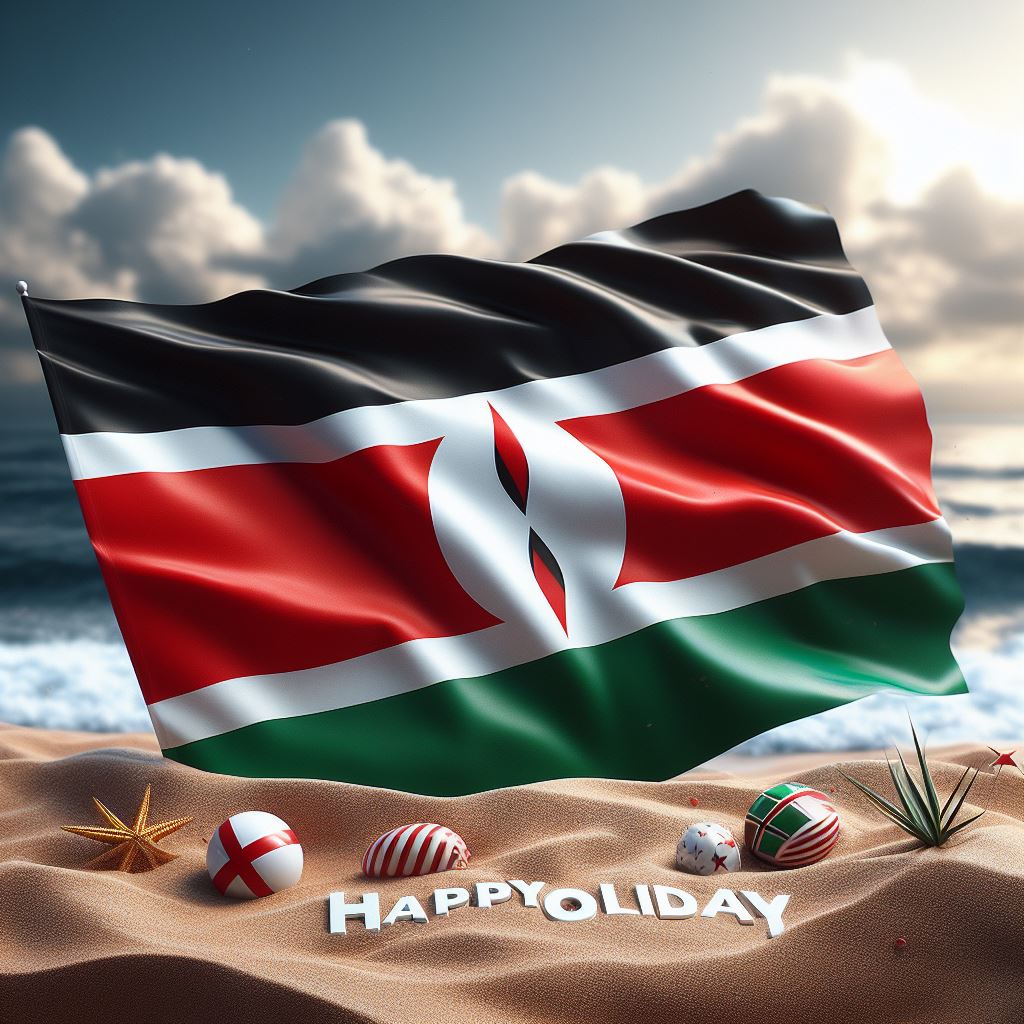
In Kenya public holidays provide the much needed but rare breaks when the public is relieved from mandatory duties and takes a rest at home. Public holidays serve several important purposes including rest and relaxation, and consolidating gatherings, particularly in Memorial Days and Labor Day. Families often plan travel and vacations around these dates. Additionally, school closures during holidays align with parents’ time off, making it easier to plan family activities.
Holidays also articulate the civic calendar and symbolism. Kenya has about 13 Holidays. Of those, six are religious holidays for Christians and Muslims, 4 mark National events , and the New year, Labor day and Boxing day as International holidays having a day each.
Public holidays with national significance hold national symbolism . Madaraka day celebrates when Kenya got self-rule, Mashujaa day honors national heroes and Jamhuri day when Kenya attained independence and became a republic.
From Moi Day to Huduma Day to Utamaduni Day and now Mazingira Day, 10th October has been a restless holiday symbolically and therefore substantively. The origins of the Holiday stems from Individualism which has led to the day generating uncertainty to its name. The proponents and opponents have tried to contextualize the concerns of the nation on this day.
Moi Day was conceived in the spirit of service to the nation; service and volunteerism. As to whether it was successful, peace, love and unity are objective measurable that many critics tend to overlook when pointing towards the hard phases of national transformation through which freedoms and liberation became tenable beyond the ills of independence and self-rule. Hence Huduma day sought to replace the Individualism of the Public Service Ideals with collectivism. This was also the case for Kenyatta Day to Mashujaa day, similar reasoning was preferred.
According to Mate Tongola of Standard Newspaper, Moi Day was scrapped way before the enactment of the current constitution in 2010 and remained so even after High Court Judge George Odunga’s ruling stating that October 10 is still a public holiday. He, however, declined to rule on how Kenyans should celebrate the day.
After 9 years, December 2019, the known unknown was referred to Huduma Day starting 2020, while Interior Cabinet Secretary Dr. Matiang’i gazetted Utamaduni Day. In the Building Bridges Initiative (BBI), it was suggested that Huduma Day be celebrated every 10th of October and December 26 be set aside for Utamaduni day.
From Moi Day to Huduma Day to Utamaduni Day and now to Mazingira Day, the verdict on what holiday is being celebrated this year lies in the gazette notice issued by the government declaring the public holiday.
Huduma Day therefore was a good day to reflect on Individualism or Collectivism in Public Service and hence public service delivery. It was also a good day to measure gains on governance, government delivery and national values as espoused by leadership. It meant to celebrate leaders that demonstrate respect for the people. To honor leaders that are honest and transparent to conflict of interest while being disciplined and committed in service of the people by giving selfless service.
Huduma Day was meant to be the day the country’s three children [Government, State and Nation] shared the same table of ideals and reflected upon their ideas. Hence from this we may postulate that the first pillar the Kenyan society is seeking is to serve others and hence SERVICE DELIVERY.
Huduma Day however was short-lived. The Uhuru administration while recognizing the need for service delivery and having moved the day further from individualism to collectivism was met with another dilemma. Kenyans were a nation without national ethos and national culture. It sought to craft a way into national ethos and national culture. Hence Utamaduni Day. But the holiday calendar was full. An attempt was made and aimed on Boxing Day since traditionally it has shallow roots of African originality. But this proofed to be confusing given it was a traditional international holiday which could not be changed. The concept could result in cultural isolationism.
Utamaduni Day needed prominence. The Uhuru administration moved to replace Huduma Day with Utamaduni Day. A day for culture and building national ethos. Hence from, reason prevailed Utamaduni Day over Huduma Day. What could have been the reason for the change of heart?
Had there been a gazette to that effect we may have avoided speculation. But the reason to the change of Huduma Day to Utamaduni Day during the handshake era is a continuation of the restlessness of the day since the promulgation of the 2010 constitution, to the supreme court overturning a parliamentary process and reinstating the day as Moi Day in 2017 before it was marked as Huduma Day in 2020 and Utamaduni Day in 2022. There could be other reasons why primacy was given to Utamaduni Day since this year the same day shall be celebrated as Mazingira Day whose clarion call will likely involve service to others and volunteerism.
Utamaduni Day sought an attempt on nation-craft. It sought to create a unified pluralism in the Kenyan culture by promoting Iconism, Symbolism, Sustainability, Originality, Uniqueness, Identity and Healing in the nation and therefrom structuring the NATIONAL ETHOS. It was creativity in pursuit of excellence; National Ethos as espoused by the Handshake administration in prioritizing NATIONAL ETHOS over SERVICE DELIVERY conscientiously.
Upon assumption of office the Ruto administration celebrated Utamaduni Day for two years before consenting and assenting to it being replaced by Mazingira Day in response to the challenges of our time ; Environmental and Climate Change. The renaming of Utamaduni Day to Mazingira Day by the Ruto Administration is meant to encourage public participation in the management, protection & conservation of the environment and therefore mitigation & adaptation towards climate change. It is a day meant to assert Environmental Rights and to do so it shall rally people to mandatory volunteer ism while serving others in taking care of the environment.
Now, it is not whether the Uhuru administration, the Handshake administration or the Ruto administration is and/or are wrong or right in the persistent changes to Moi Day. It is the ethics that establishes the primacy of Environmental Rights over National Ethos and Service Delivery that we query. According to the Ruto Administration given mandatory freedom of time, one ought to pursue environmental rights as a priority when invoking the spirit of service to others and volunteerism. While the Handshake administration concurred that it’s more urgent and cogent to pursue national ethos, the Uhuru administration was of the opinion that service delivery is in service of others and volunteerism.
The Ethics in pursuance of service delivery, environmental rights and national ethos ought to guarantee individual or collective achievements. Is it morally ethical to in principle pursue common but differentiated goals or individual but integrated goals?
Happy are a people with a national ethos,
For their leadership will be committed to service delivery,
Happy are a people whose leaders commit to service delivery,
For they won’t have to worry about Environmental Rights,
Happy are a people with environmental rights that they obtain and observe by their character and values when volunteering to serve while celebrating and practicing National Originality, National Iconism, National Identity, National Uniqueness and National Symbolism while promoting National Healing for National Sustainability.